Higher-Order Functions in JavaScript, Explained Simply
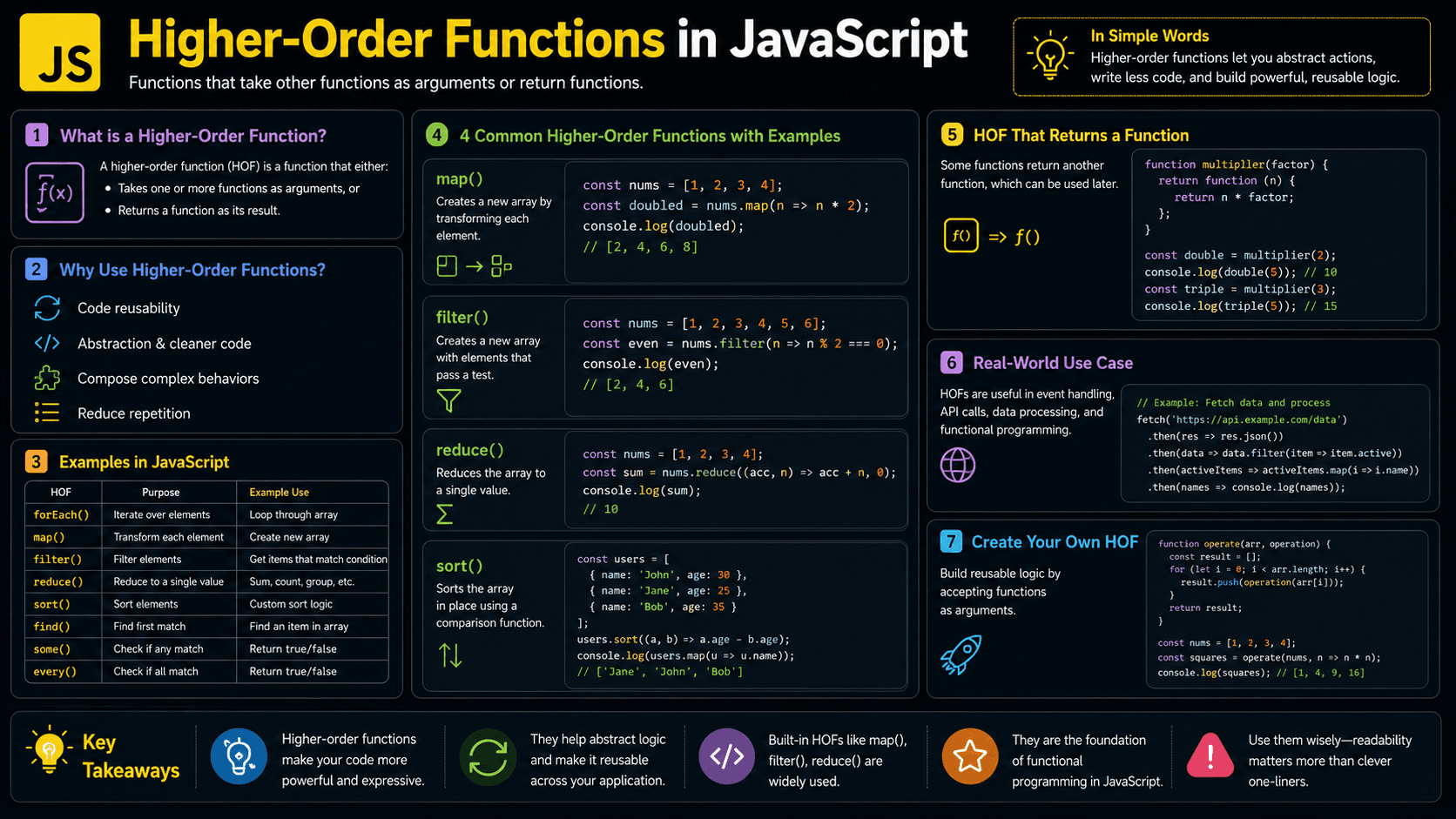
Have you ever passed a function into map, returned a function from another function, or wired up an event handler? If so, you've already used higher-order functions in JavaScript — maybe without realizing it.
The idea is simple: higher-order functions let you separate what should happen from when or how it happens. That one split powers array methods, event listeners, middleware, React handlers, validation pipelines, and a long list of other patterns you'll meet in real projects.
You've probably written one already. Every time you call map with a function, that function is the customizable part — map handles the looping:
[1, 2, 3].map((number) => number * 2); // [2, 4, 6]That's the whole idea in one line. The rest of this guide unpacks why it works and where it shows up.
What You'll Learn
We'll build up higher-order functions from first principles, then look at how to use them without turning your code into a puzzle.
- Why higher-order functions exist
- How functions can be passed and returned like other values
- How
map,filter, andreduceuse callback functions - What happens inside the JavaScript runtime
- Common mistakes and practical best practices
- How to recognize higher-order functions in real projects
Prerequisites for Learning Higher-Order Functions
You don't need much to follow along — just a basic grasp of JavaScript functions, arrays, and callbacks.
Review these topics if functions and callbacks are still unfamiliar:
You can also test your foundation:
Why Do Higher-Order Functions Exist?
They exist to make repeated behavior reusable and configurable. Without them, you'd write a separate loop and function for every small variation of a task. When you pass behavior in as a function, a single operation can sort, transform, validate, or respond differently — no duplicating the logic that surrounds it.
Think about writing a fresh array loop every time you need to double numbers, format names, or pull out a property. That gets old fast. Higher-order methods like map hand you the loop for free, and your callback just describes the transformation.
JavaScript can do this because functions are first-class values. A function can be stored in a variable, tucked into an object, passed as an argument, or returned from another function — the same as any string, number, or array.
Memorable rule: Higher-order functions reuse behavior by receiving or producing other functions.
A Mental Model for Higher-Order Functions
Picture a delivery driver working from a set of instructions. The driver already knows how to reach each address. The instructions decide what happens once they arrive: drop off a package, collect a signature, or inspect an item.
A higher-order function is like the driver. It manages the repeated process, while another function supplies the customizable instructions.
When you call map, the method handles moving through the array. The callback tells it what to produce for each item. When a function returns another function, it is preparing a customized instruction that can be used later.
The problem being solved is repetition. Instead of rebuilding the entire process whenever one behavior changes, you keep the process and replace only the instructions.
Under the hood, those "instructions" are just function values. JavaScript passes them between functions exactly the way it passes strings, numbers, arrays, and objects.
A Real-Life Analogy: Ordering a Custom Drink
A coffee machine follows a fixed process: prepare a cup, add ingredients, serve the drink. The recipe you pick changes what comes out.
The machine is the higher-order function, and the recipe is the callback. One reusable process makes coffee, tea, or hot chocolate because the part that changes is supplied separately.
A function factory runs the same idea in reverse. You choose a setting, say "large," and get back a customized recipe that remembers your choice.
What Is a Higher-Order Function in JavaScript?
A higher-order function in JavaScript is a function that takes one or more functions as arguments, returns a function, or both. By treating functions as values, it unlocks reusable behaviors like array transformations, event handling, middleware, decorators, and function composition.
Here's a function that accepts an operation and then calls it:
function calculate(firstNumber, secondNumber, operation) {
  return operation(firstNumber, secondNumber);
}

function add(left, right) {
  return left + right;
}

const total = calculate(8, 4, add);

console.log(total); // 12
calculate is a higher-order function because it accepts add as an argument. The add function is the callback.
A callback is a function passed to another function. The function receiving or returning it is the higher-order function.
How Do Higher-Order Functions Work in JavaScript?
It works by receiving a function value, returning one for later use, or both. Behind the scenes, the JavaScript engine sets up execution contexts, pushes function calls onto the call stack, resolves variables through lexical scope, and keeps referenced values in memory as long as they're still reachable.
Create the function values
JavaScript creates function objects for the higher-order function and its callback.
Pass the callback
The callback's function value is supplied as an argument. It is not executed unless parentheses are used.
Call the higher-order function
JavaScript creates its execution context and places the call on the call stack.
Execute the callback
The higher-order function invokes the callback with the required arguments.
Return the result
The callback result is used, collected, or returned according to the higher-order function's logic.
For calculate(8, 4, add), the flow can be pictured as:
calculate(8, 4, add)
        |
        +-- operation refers to add
        |
        +-- operation(8, 4)
                  |
                  +-- returns 12
        |
        +-- returns 12
Think Like the JavaScript Engine
To the engine, each function is just an object you can reference and call. Passing a function around doesn't copy its source code or run it — it only hands over a reference.
- Memory is allocated: Function declarations create function objects, and variables hold references to them.
- An execution context is created: Calling the higher-order function creates local parameters and variables.
- The call enters the call stack: The engine tracks the currently executing function.
- The callback is invoked: A new execution context is created for the callback and added to the stack.
- Scope is resolved: The callback uses its lexical environment and scope chain to find variables.
- Calls return: Callback and higher-order function contexts are removed from the stack.
- Memory becomes collectible: Unreachable function objects and captured values may be reclaimed by garbage collection.
When a higher-order function returns a function that uses outer variables, a closure keeps those variables reachable:
function createMultiplier(factor) {
  return function multiply(number) {
    return number * factor;
  };
}

const triple = createMultiplier(3);

console.log(triple(5)); // 15
Notice that triple can still reach factor even after createMultiplier has finished running. Its lexical environment holds onto that reference for as long as triple exists.
Passing Functions Versus Returning Functions
Higher-order functions usually show up in one of two forms, though a single function can use both at once.
| Pattern | What it does | Common examples |
|---|---|---|
| Accepts a function | Customizes an operation | map, filter, event listeners |
| Returns a function | Creates specialized behavior | Function factories, decorators |
| Accepts and returns functions | Wraps or combines behavior | Middleware, composition, memoization |
Passing a Callback to Transform Data
The map method is a built-in higher-order function. It runs your callback on every array element and builds a new array from whatever each call returns.
const prices = [10, 25, 40];

const pricesWithTax = prices.map(function addTax(price) {
  return price * 1.2;
});

console.log(pricesWithTax); // [12, 30, 48]
Returning a Customized Function
A function can also hand back another function that's already configured with an earlier value:
function createMinimumValidator(minimum) {
  return function isValid(value) {
    return value >= minimum;
  };
}

const isAdult = createMinimumValidator(18);

console.log(isAdult(21)); // true
console.log(isAdult(16)); // false
It's a handy pattern when several operations need to share the same configuration.
Higher-Order Function Examples with Map, Filter, and Reduce
JavaScript's array methods lean on higher-order functions to turn data processing into a readable chain of transformations.
const orders = [
  { customer: 'Ava', total: 45, paid: true },
  { customer: 'Noah', total: 20, paid: false },
  { customer: 'Mia', total: 70, paid: true },
];

const paidRevenue = orders
  .filter((order) => order.paid)
  .map((order) => order.total)
  .reduce((sum, total) => sum + total, 0);

console.log(paidRevenue); // 115
Each method has a distinct job:
filterkeeps elements for which the callback returns a truthy value.maptransforms each element and returns a new array.reducecombines all elements into one accumulated result.forEachperforms an operation for each element and returnsundefined.
Combining Functions with Composition
Composition wires functions into a pipeline, where the output of one becomes the input of the next.
function compose(...functions) {
  return function composed(value) {
    return functions.reduceRight(
      (result, currentFunction) => currentFunction(result),
      value,
    );
  };
}

const trimText = (text) => text.trim();
const toLowerCase = (text) => text.toLowerCase();
const replaceSpaces = (text) => text.replaceAll(' ', '-');

const createSlug = compose(replaceSpaces, toLowerCase, trimText);

console.log(createSlug('  Higher Order Functions  '));
// "higher-order-functions"
compose is higher-order in both directions: it accepts functions and returns a new function.
How to Recognize Higher-Order Functions in Real Code
Watch for parameters named callback, handler, predicate, reducer, middleware, or transform. Arrow functions passed straight into a method, like items.filter(item => item.active), are another dead giveaway.
Common production patterns include:
- Array methods such as
map,filter,reduce, andsort - DOM event handlers passed to
addEventListener - React event props and state updater functions
- Express middleware receiving or returning handlers
- Validation and data-transformation pipelines
- Decorators, memoization utilities, and function composition
- Factory functions that return configured functions
There's no special keyword to look for — JavaScript has no higherOrder syntax. You spot the pattern by asking one question: does this function receive or return another function?
Common Higher-Order Function Mistakes
Most trip-ups come down to a few habits: calling a callback too early, forgetting to return a value, mutating shared data, or reaching for an abstraction the code didn't need.
Common mistake: transform() executes a function immediately, while
transform passes the function itself as a value.
const numbers = [1, 2, 3];

function double(number) {
  return number * 2;
}

const doubled = numbers.map(double());
// TypeError: the value passed to map is not a function
Forgetting to Return from an Arrow Function
Once you add braces, you've created a function body — and that means you need an explicit return.
const scores = [40, 75, 90];

// ❌ No value is returned from the callback
const incorrectResults = scores.filter((score) => {
  score >= 60;
});

console.log(incorrectResults); // []
const scores = [40, 75, 90];
// ✅ Implicit return without braces
const passingScores = scores.filter((score) => score >= 60);
console.log(passingScores); // [75, 90]Choosing the Wrong Array Method
Don't reach for map when all you need is a side effect, and don't expect forEach to hand back a transformed array.
| Goal | Appropriate method |
|---|---|
| Transform every item | map |
| Keep selected items | filter |
| Produce one accumulated value | reduce |
| Run a side effect | forEach |
| Find one matching item | find |
| Test whether any item matches | some |
Best Practices for Clear Higher-Order Functions
The best higher-order functions keep the repeated control flow in one place and the small, focused behaviors in another.
Name your callbacks: When the logic is long, reused, or hard to read inline, give the callback a real name.
Keep callbacks pure: Prefer callbacks that return a value instead of mutating outside variables. Predictable callbacks are far easier to test and combine.
A few more guidelines worth keeping in mind:
- Keep each callback focused on one responsibility.
- Choose parameter names that explain the callback's role.
- Avoid deeply nested higher-order calls.
- Use
map,filter, andreduceonly when they clearly express the goal. - Document function factories when returned functions capture configuration.
- Avoid creating abstractions that are used only once and add no clarity.
Real-World Uses of Higher-Order Functions
You'll find higher-order functions anywhere an application needs behavior that's configurable or reusable.
- User interfaces: Event listeners receive handler functions.
- React applications: Event props, state updater callbacks, and custom hooks frequently accept functions.
- Node.js servers: Middleware functions process requests in a configurable chain.
- Data processing: Array methods transform API responses and database results.
- Validation: Reusable factories create validators for different rules.
- Testing: Utilities receive setup, assertion, or mock functions.
- Performance tools: Debounce, throttle, and memoization utilities wrap existing functions.
Asynchronous callbacks used by timers, promises, or browser events also involve the event loop. Higher-order functions themselves are not automatically asynchronous; the API controlling the callback determines when it runs.
Higher-Order Function Interview Questions
These come up often in interviews because they check two things at once: whether you know the definition and whether you understand how higher-order functions actually behave.
Frequently Asked Questions About Higher-Order Functions
Short answers to the questions that come up most often about higher-order functions in JavaScript.
Related JavaScript Topics and Quizzes
Keep going with callbacks and closures, or put your understanding to the test with some hands-on questions.
Learn how callbacks are passed, invoked, and used by synchronous and asynchronous APIs.
Understand how returned functions retain access to variables from their lexical scope.
🔑 Key Takeaways
Higher-order functions make behavior reusable by treating functions as values.
- A higher-order function accepts a function, returns a function, or does both.
- Callbacks provide customizable behavior to reusable operations.
map,filter, andreduceare built-in higher-order functions.- Returned functions can preserve configuration through closures.
- Pass
callback, notcallback(), when an API expects a function. - Use higher-order functions when they make intent clearer, not simply to shorten code.
Test Your Higher-Order Function Knowledge
Reading through the examples is a solid start. The real learning happens when you predict outputs, spot the callbacks, and fix the common mistakes yourself.